

Apr 17th, 2026
How to Build a Cloud Migration Roadmap for Your Organization
Organizations today see cloud adoption not just as a technology upgrade, but also to accelerate innovation, modernize operations, and compete in a more digital marketplace through modern cloud technology capabilities. However, moving applications and data to the cloud, especially in environments that involve cloud app development, is still complex and operationally challenging. Without a clear strategy and a structured plan, organizations face risks like delays, budget overruns, and service disruptions.
A cloud migration roadmap is essential. It acts as a strategic framework to help transition from old infrastructure to a modern cloud environment. This process should be controlled and focused on delivering value while managing risks, resources, operational needs, and business goals.
This article presents a practical, step-by-step guide to building a cloud migration roadmap that connects technology initiatives with enterprise strategic priorities.
What is a Cloud Migration Roadmap
A cloud migration roadmap is a detailed plan outlining how an organization will migrate its applications, data, and computing workloads from legacy systems or on-premises environments to a new cloud environment. This process is carried out carefully and in an organized manner.
It sets clear goals, identifies priorities, assigns responsibilities, and outlines tasks and milestones. This structure allows teams to carry out migrations in a coordinated, predictable, and organized way.
At its core, the roadmap ensures that technical decisions support business outcomes such as cost optimization, improved performance, operational agility, and compliance.
Why a Lifecycle Perspective Is Critical to Cloud Migration
By moving tasks through planned stages, including assessment, planning, execution, stability, and optimization, a lifecycle approach sees cloud migration as an ongoing transformation program instead of a single event. This method guarantees clear business value throughout the migration process.
By viewing migration as a series of steps rather than a single significant technology change, organizations enable learning, flexibility, and ongoing improvement.
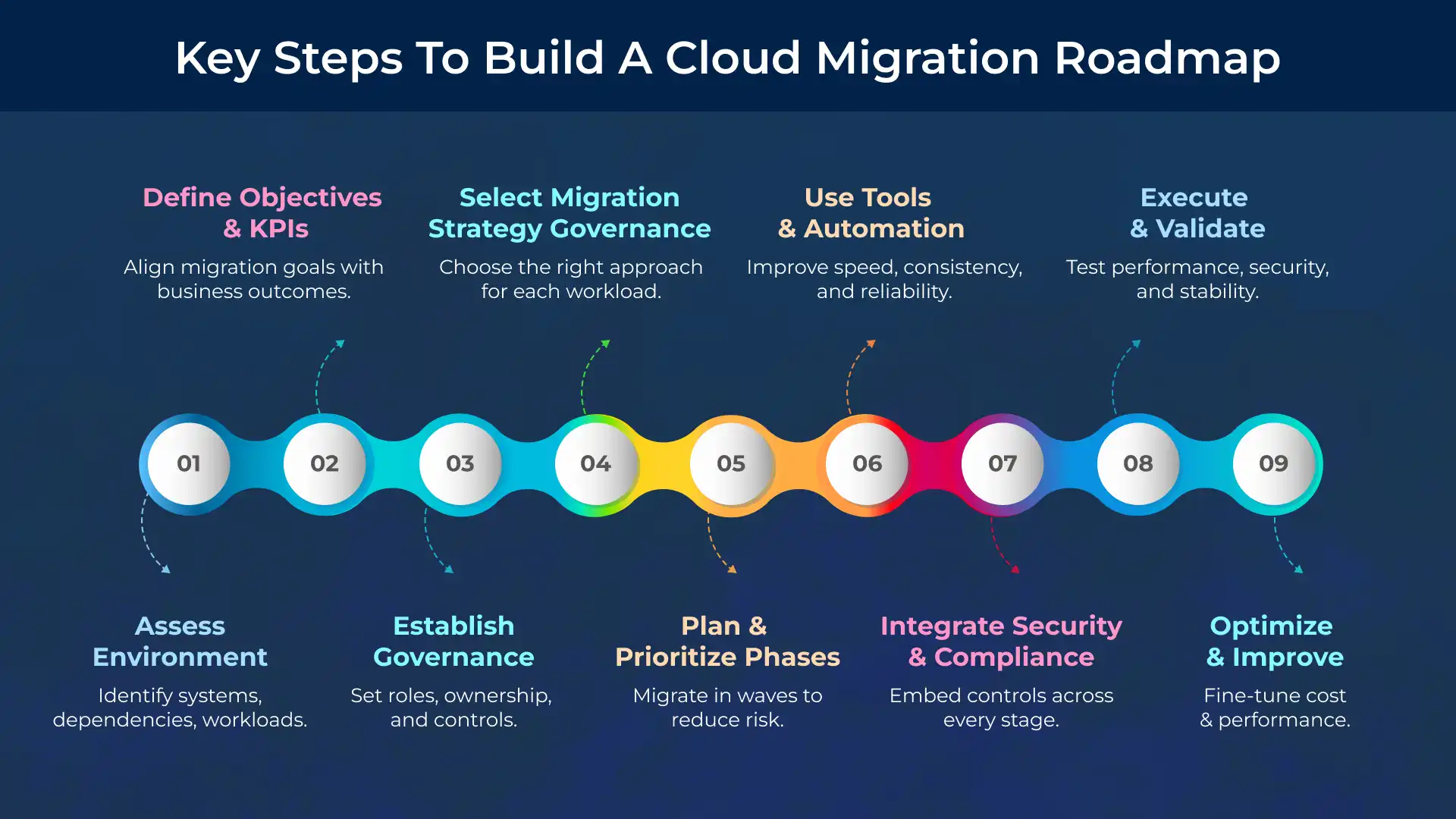
Step 1: Conduct a Thorough Assessment
The first and most critical step in a cloud migration plan would be to conduct a comprehensive assessment of the existing environment. Map dependencies, assess performance, and identify integration risks by creating an automated discovery list of servers, apps, databases, storage, networks, middleware, and connectors.
The emphasis should be on the dependency mapping to prevent errors during the migration phase. Review legacy systems for retirement or upgrades. Check licensing and support limits. Classify data based on regulatory needs and sensitivity.
The assessment should also consider skills availability across teams and identify capability gaps that may require training or external expertise. The result of this phase is a clear understanding of what exists today and what must be modernized, prioritized, or retired.
Step 2: Define Business Objectives and KPIs
Successful cloud migrations are driven by business outcomes rather than technology decisions alone. Your roadmap should clearly define why the migration is being undertaken and what value the organization expects to deliver.
Common objectives include:
- Reducing infrastructure and maintenance costs
- Increasing application performance and reliability
- Facilitating faster cycles of innovation and scalability
- Increasing security and adhering to regulations
- Assisting with new product capabilities and digital initiatives
These objectives should be measurable. Set key performance indicators. Include uptime targets, response-time thresholds, cost-reduction goals, and operational efficiency metrics. By clearly defining specific outcomes at the start, the organization makes sure that every migration decision delivers measurable business value.
Step 3: Establish Governance and Team Structure
Cloud migration demands careful planning and cross-departmental collaboration. A governance model should be developed that includes representatives from the Operations, Finance, Security, IT, and Business Leadership Departments.
Clearly state who is responsible for decision-making, risk management, expense monitoring, and confirming compliance. Team responsibility and coordination are ensured by hiring a qualified cloud transformation owner or migration program lead.
Governance checkpoints should be embedded throughout the roadmap to review alignment, progress, risk exposure, and cost performance.
Step 4: Select the Right Migration Strategy
At this stage, determine the most appropriate migration strategy for each workload or application. Not every system should be migrated in the same way.
Understanding the 7R Cloud Migration Strategies
1. Rehost
Rehost means that application workloads are moved to a cloud with minimal modifications. There is a copying of existing configurations or infrastructure patterns. The process increases migration speed while ensuring everything remains the same, with no changes required.
2. Relocate
Relocate moves entire workloads or virtual machines to a cloud provider’s infrastructure with few architectural changes. It uses cloud-hosted infrastructure while keeping existing configurations, operational processes, networking, and management models unchanged.
3. Replatform
Replatforming existing workloads by adding new platforms and features while retaining the workload’s primary architecture will improve performance, scalability, and compatibility with a cloud environment. This method allows for gradual modernization during workload migration while maintaining much of the technical debt associated with the workload.
4. Refactor
Refactor redesigns application components or code to use cloud-native structures, such as microservices and containerization. This change improves scalability, resilience, and maintenance. It also opens the door to better automation and long-term innovation.
5. Repurchase
Repurchase replaces SaaS or cloud-based platforms with options that have similar or improved features compared to outdated apps. This update reduces maintenance costs, simplifies licensing, and helps with modernization. It also makes it faster to use standard features.
6. Retire
Retirement removes old systems that no longer benefit the business. It eliminates assets to cut operational costs, reduce security risks, and reduce technical debt. This process also makes migration easier.
7. Retain
Retain keeps specific workloads or systems on-site or in hybrid environments because of latency, compliance, integration, or business needs. It supports coexistence while allowing surrounding services to use the cloud and creates options for future modernization.
This selective approach prevents unnecessary modernization efforts and ensures migration efforts are focused where they create the most business value.
Step 5: Plan Migration Phases and Prioritization
Instead of one big move, cloud migration should occur in planned stages. Workloads should be categorized into migratory waves based on their dependency, complexity, and importance. This approach lowers risk while ensuring that services continue to operate as intended.
A phased plan typically includes:
- Pilot program to test procedures and technologies for low-risk workloads.
- Phase of core migration for significant sequenced wave applications.
- Stabilization phase to monitor performance and fix any issues after migration.
- Optimization phase to improve cost, scalability, and operations.
Every stage should specify acceptance standards, testing checkpoints, rollback protocols, and entry and exit criteria. This reduces downtime and allows workloads to be moved in a predictable, orderly manner that aligns with business goals.
Step 6: Select Proper Tools and Automation
Migration speed, reproducibility, and robustness improve significantly with the right tools that enable consistent execution and reduce manual effort. Automated testing, environment replication, data synchronization, dependency discovery and mapping, CI/CD pipelines, Infrastructure-as-Code, process orchestration, rollback validation, configuration management, performance testing, monitoring, and logging should all be supported by these tools.
Functions such as automated configuration management, pipeline-based deployments, and infrastructure-as-code help minimize manual intervention and ensure consistency. Further, it provides assistance with rewind functionality, validation, and quick fixes in case unforeseen issues occur during migration.
Step 7: Integrate Security and Compliance
Security and compliance need to be part of the roadmap from the start; they should not be added later.
Key security activities include:
- Classifying data and mapping regulatory obligations.
- Defining encryption for data in transit and at rest.
- Implementing identity and access management policies.
- Establishing logging, monitoring, and incident response workflows.
Integrating security early reduces rework, minimizes operational risk, and strengthens organizational trust in the migration process.
Step 8: Execute Migration and Validate
After setting up the planning and governance structure, migration execution begins in accordance with the migration phase plan.
These validation activities include:
- Testing applications’ functions in the operational environment.
- Benchmarking of Performance on Pre-Migration Bases.
- Verification of security and access controls.
- User Acceptance Testing & Operational Readiness Review Responsibilities
Rollback plans must be prepared for every migration to maintain business continuity in the face of unexpected failures.
Step 9: Post-Migration Optimization and Continuous Improvement
Post-migration optimization ensures workloads run well in the cloud. It also helps them operate efficiently, securely, and without wasting money. After stabilization, organizations should review performance metrics, resource use, and workload behavior. This will help identify chances for improvement, such as adjusting instance sizes, fine-tuning autoscaling policies, increasing storage efficiency, and modifying network setups.
Cost governance should be reinforced through monitoring, budgeting controls, and usage analysis. Security controls, access policies, and compliance requirements must be reassessed in the new environment.
Continuous improvement enables teams to modernize further, adopt cloud-native services, strengthen cloud technology capabilities, and enhance reliability and long-term business value.
From Planning to Execution: Realizing the True Value of Cloud Migration
A cloud migration roadmap is an essential strategic instrument that guides an organization through a complex transformation journey. By using a straightforward, lifecycle-driven method, organizations can reduce risk, manage costs, maintain operational continuity, and gain ongoing business value from cloud adoption.
At Telliant Systems, we help enterprises architect, plan, and execute cloud migration programs that align technology modernization with business outcomes. Our consulting and engineering teams work closely with organizations to design migration roadmaps that are practical, measurable, and tailored to their strategic priorities.