




Jan 9th, 2026
Functional Testing Services Explained: Best Practices, Process, ROI
Functional testing is one of the primary quality assurance disciplines, ensuring that software operates as expected according to both business goals and technical requirements. Instead of looking at the internal code, functional testing checks whether important features, workflows, and integrations function correctly in real-world situations.
In modern software environments, even minor functional issues can disrupt business processes, delay releases, and increase operational risk. Good functional testing helps solve these problems by consistently verifying application behavior early. This approach allows organizations to deliver software that is stable, predictable, and reliable.
This article looks at functional testing services from the perspective of delivery and execution. It explains how functional testing is set up and carried out, highlights best practices that improve release stability and quality, and discusses how organizations can track their return on investment through lower defect costs, quicker release cycles, and a better user experience.
What Is Functional Testing?
Functional testing is a software testing technique that verifies the actions and outputs of software features against the requirements outlined in functional specifications, user stories, use cases, or business process models. It is usually done without considering the internal code structure. This black-box approach concentrates only on inputs, user actions, and expected outputs.
This method works for individual features, such as authentication flows, as well as for complete workflows that involve multiple modules or services. Functional testing validates software behavior from a business perspective, ensuring the application consistently delivers the intended value.
Functional Testing vs Non-Functional Testing
Setting reasonable expectations for the scope and results of testing requires an understanding of the distinction between functional and non-functional testing. Both are necessary for software quality, but they deal with different risks.
| Aspect | Functional Testing | Non-Functional Testing |
|---|---|---|
|
|
|
|
|
|
|
|
|
|
|
|
|
|
|
From a business standpoint, functional testing forms the foundation of quality assurance. A system that performs well under load but delivers incorrect results still fails to meet its core purpose.
Functional Testing Process
A clear, repeatable process ensures that functional testing is measurable, traceable, and aligned with delivery goals. Most functional testing services follow a structured lifecycle.
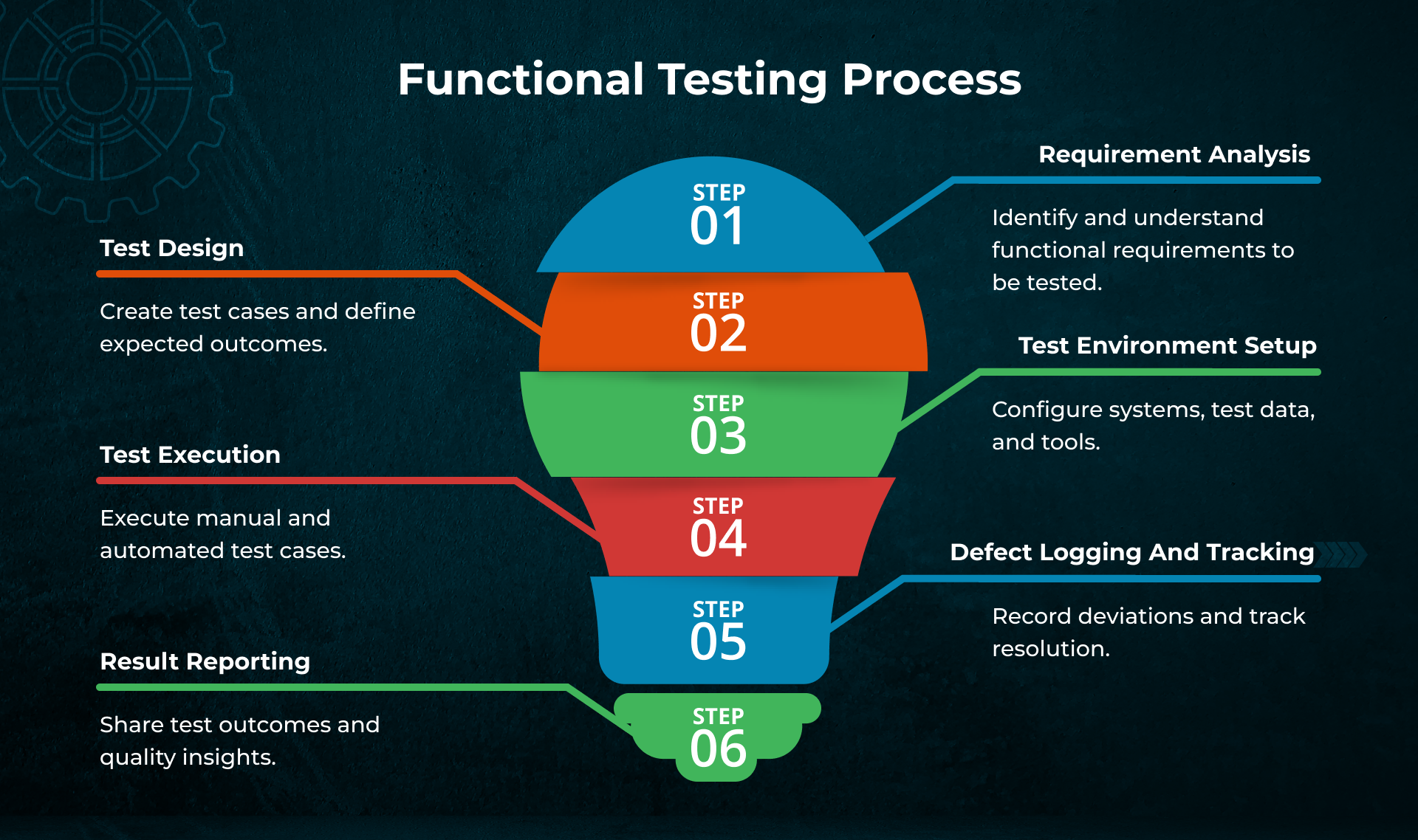
This process ensures that functional coverage remains aligned with documented requirements and business expectations throughout the software development lifecycle.
Types of Functional Tests Covered
Functional testing services normally consist of multiple testing levels that are combined to guarantee complete coverage
- Unit Testing: Validates individual functions or components in isolation.
- Integration Testing: Verifies interactions between integrated modules or services.
- System Testing: Evaluates the complete application in an end-to-end environment.
- Regression Testing: Tracks the existing functionality that has not been affected by recent code changes.
- User Acceptance Testing: Confirms that the system meets business expectations using real-world scenarios.
Each type addresses a different risk level and collectively strengthens software reliability.
Best Practices for Functional Testing
- Features that influence customer satisfaction, company revenue, and compliance should be tested before others.
- Each test case must be associated with the requirements to ensure complete coverage and the ability to assess the effect.
- For repeatable scenarios, use automation; for exploration and usability, use manual testing.
- To minimize rework, provide quicker feedback, and stabilize releases, run tests early in the development process.
- Maintaining proper test documentation will not only facilitate audits and communication but will also be a continual source of quality improvement.
Measuring ROI of Functional Testing Services
ROI from functional testing services is driven by both direct financial savings and indirect operational improvements.
Key ROI Drivers
- Reduced defect-resolution costs: Fixing defects found during development is much cheaper than fixing those found in production.
- Faster release cycles: Good functional testing reduces release delays and the need for post-release fixes.
- Improved customer experience: The number of functional defects that reach production is reduced, leading to higher user satisfaction and lower support costs.
- Actionable quality metrics: Metrics like defect leakage, test coverage, and cycle time help measure quality improvements.
Functional Testing Service Delivery Models
Functional testing services can be delivered through:
- In-house QA teams are embedded within development teams.
- Dedicated testing partners with scalable knowledge
- Hybrid approaches that combine external execution with internal ownership
Final Perspective
Functional testing is a crucial component of quality control, ensuring that software applications function as intended. It checks that important features meet documented requirements and deliver reliable results for users, confirming that the system behaves as the business and end users expect before release.
This methodical approach produces quantifiable business outcomes. Organizations gain improved release stability, faster time-to-market, lower defect repair costs, and increased customer satisfaction. Functional testing services provide long-term investment in software quality. This investment directly supports operational strength and continuous business expansion.