




Jan 23rd, 2026
Why Technical Debt Builds Faster Than You Think
Technical debt has always been part of building software, but today it grows faster than most teams realize. With distributed architectures, endless integrations, and constant release pressure, complexity builds up quickly.
Even well-performing teams find that hidden issues and aging components creep in faster than they can manage. That is when legacy app modernization steps in as the most dependable way to stabilize systems and support business growth.
1. What Technical Debt Really Means Today
Old frameworks, temporary solutions, postponed migration work, and integrations that fail at scale are all sources of technical debt that were previously kept under control through gradual changes to legacy systems. Today, rapid CI/CD pipelines, cloud-native setups, and expanding microservices create far more chances for things to drift out of sync and introduce inconsistencies.
These factors typically show up as:
- Old frameworks that slow down development and modernization
- Temporary fixes that were never refactored
- Postponed migration work that accumulates over time
- Integrations that cannot be scaled with system growth
- CI/CD and cloud-native changes that introduce drift and inconsistencies
Legacy application modernization is now necessary for resetting the engineering foundation. It helps reduce long-term structural and code-level debt, through focused application modernization strategies that tackle both technology and architecture.
2. The Hidden Accelerators: Factors That Increase Technical Debt
Several modern-day factors have contributed to technical debt. These are frequently ignored until delivery intervals or performance start to decline.
-
Fragmented technology stacks
Teams use specialized tools across analytics, security, CI pipelines, communication, and deployment. Even though each tool addresses a different issue, maintaining the entire ecosystem becomes difficult. Updates, patches, and compatibility issues are increasing exponentially.
-
Pressure for constant releases
Product teams push for continuous delivery, but rapid cycles often introduce shortcuts. Temporary code becomes permanent far too often, accumulating across sprints and releases.
-
Cloud evolution and vendor dependency
Cloud providers regularly modify configurations, discontinue certain services, and update APIs. Teams that are unable to keep up are left with weaker security coverage, misaligned infrastructure, and version problems.
-
Skill gaps across engineering teams
Technologies such as serverless, orchestration, and distributed tracing evolve rapidly. When teams have different levels of expertise, it leads to inefficient implementations, duplicated services, and inconsistent architectural patterns.
-
Integration overload
Modern systems depend on external services for payments, authentication, analytics, and operations. Each integration brings additional maintenance needs and potential failure points.
-
Data growth beyond initial assumptions
Slow queries, storage concerns, and indexing challenges arise as data volume grows. A performance bottleneck is caused by what once worked.
3. How Modern Engineering Practices Can Backfire
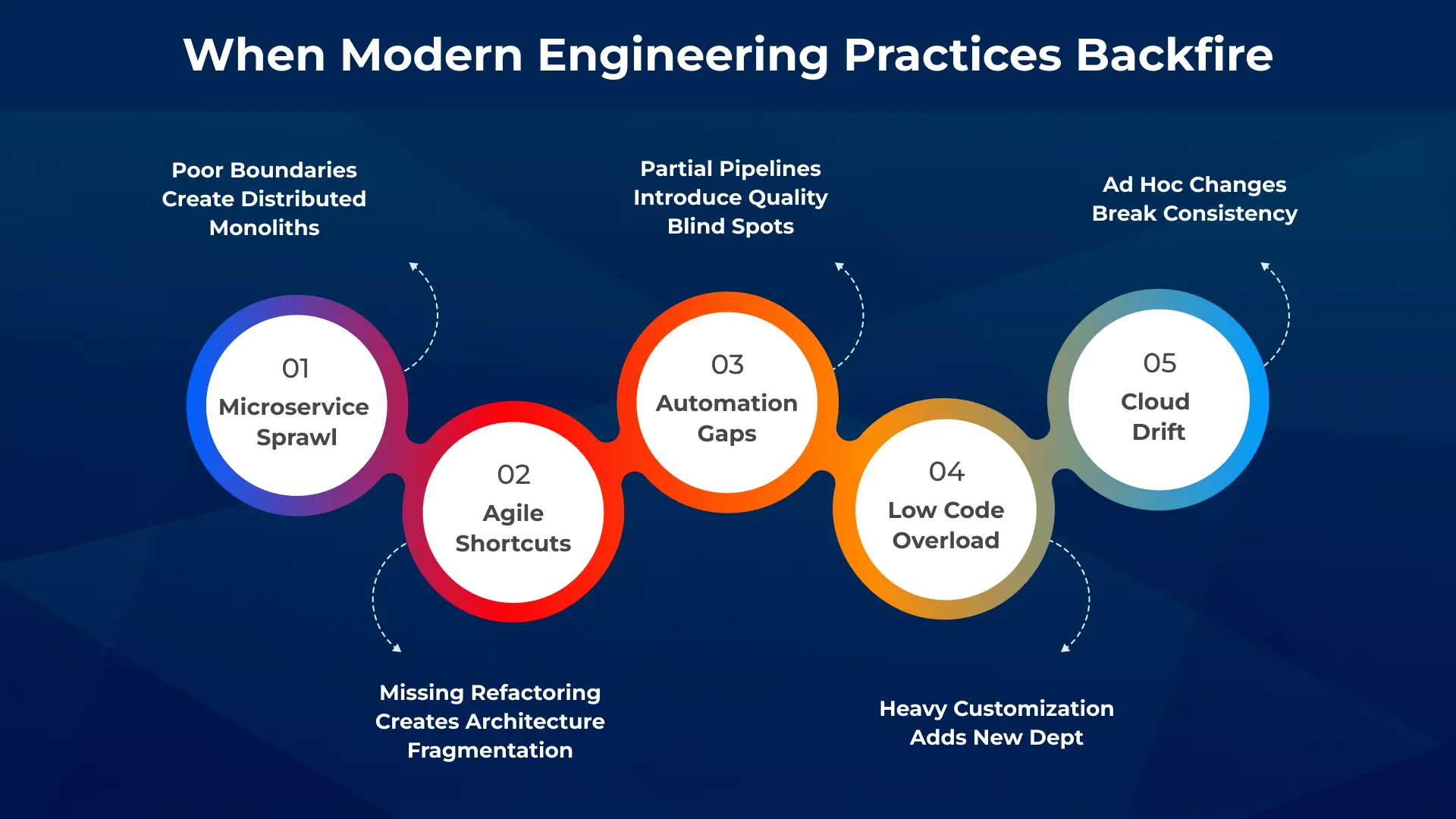
Engineering teams adopt modern methods to increase scalability and improve delivery speed. Yet, without architectural governance, these practices can produce the opposite effect.
-
Undefined microservice boundaries
Microservices offer modularity, but when boundaries are unclear, they grow into tangled systems. This increases operational overhead and makes debugging, scaling, and testing far more complicated.
-
Agile without refactoring
Agile encourages quick delivery, but the architecture eventually breaks apart in the absence of specific cleanup cycles. While new features are still being released, technical debt quietly accumulates.
-
Partial DevOps automation
Although inconsistent test coverage leads to blind spots, automation improves reliability. While some components require little protection, others require extensive validation.
-
Over-customized low code
Low-code tools speed up development. Yet, heavy customizations create long-term maintenance challenges and add a new layer of technical debt.
-
Uncontrolled cloud drift
Infrastructure-as-code helps ensure consistency, but ad hoc environment changes cause drift. This leads to unpredictable behavior and harder-to-maintain cloud setups.
These examples show why many teams later turn to legacy app modernization or seek targeted application modernization strategies to restore architectural consistency.
4. The Real Cost: How Technical Debt Impacts Product Roadmaps and Performance
Each aspect of the product lifecycle is eventually impacted by technical debt. Teams spend more time managing problems and less time producing value due to outdated components, fragmented architecture, and increasing dependencies. As engineering’s focus shifts to maintenance, performance and scalability degrade, and release cycles slow down.
As security and compliance risks increase from unpatched parts of the system, the ability to innovate gradually decreases. It becomes challenging to execute product roadmaps predictably, and as a result, most companies are considering legacy application modernization to restore stability and enable long-term agility.
These impacts typically appear as:
- Slower feature delivery
- Performance and scalability issues
- Security and compliance exposure
- Reduced innovation capacity
5. Strategies to Identify, Manage, and Reduce Technical Debt
-
Conduct recurring codebase and architecture assessments
Every 2 or 3 months, perform audits to assess the architecture and codebase. Such a method helps spot the riskiest modules, outdated packages, and incorrect architectural patterns. With a structured scoring system in place, teams can prioritize which issues to address first and focus their fixes on the areas with the most significant impact.
-
Adopt a modernization roadmap
Legacy app modernization should be approached as a phased program covering architecture redesign, refactoring, API consolidation, cloud optimization, and database modernization. These phases serve as core application modernization strategies for long-term improvement.
-
Embed refactoring into sprint planning
Refactoring should not be an afterthought. Allocating a fixed percentage of each sprint for cleanup ensures continuous improvement.
-
Standardize engineering practices and architectural patterns
A strong engineering playbook with clear guidelines on frameworks, naming conventions, testing methods, and deployment strategies reduces inconsistencies across teams.
-
Prioritize modernization driven by business value
Not all debt is equally harmful. Businesses should upgrade the parts of their software that directly impact performance, scalability, compliance, or revenue. This disciplined approach reinforces legacy application modernization initiatives and ensures it delivers tangible results.
6. When to Ask for Help: Partnering With Engineering Experts
There is a time when the internal capabilities and skills are no longer sufficient to handle the increasing debt or to facilitate the modernization on a large scale. External engineering partners, like Telliant, help organizations accelerate modernization efforts, boost performance, and rebuild architectural foundations through structured legacy application modernization programs.
Organizations typically see substantial value in seeking support when they need
- A thorough approach to modernizing architecture
- Professional performance engineering for high-load systems
- Extensive codebase audits to find hidden dangers
- Capabilities for long-term product engineering for sustainable expansion
Expert partners bring methodologies, specialized skills, and the ability to execute complex application modernization strategies effectively.