




Jan 2nd, 2026
The Hybrid Engagement Model: Balancing Onshore and Offshore Software Teams
Software-driven companies no longer compete only with features or speed to market. They now compete on how well they build, scale, and manage engineering operations across global talent networks, increasingly through a hybrid software development model. As digital platforms become more complex, delivery models that depend entirely on onshore or offshore teams find it harder to maintain speed, cost efficiency, and operational control simultaneously.
The hybrid software development model offers a distinct option by integrating onshore, nearshore, and offshore teams into a cohesive delivery framework. In this combined software development approach, onshore teams manage product strategy and design. Nearshore teams improve collaboration. Offshore teams handle extensive execution.
The sections that follow look at how teams engage, the technical basics, governance controls, and best practices that define effective hybrid delivery between offshore and onshore teams.
Engagement Models in Software Development
Enterprises generally operate within three primary engagement models. The onshore delivery option provides enterprises with real-time collaboration opportunities, closer alignment with regulations and laws, and seamless integration into their business; however, due to its premium nature, it costs more than other alternatives.
On the other hand, offshore delivery provides enterprises with significant cost savings and the ability to scale their businesses rapidly; however, with this model, enterprises often experience delays in team coordination, increased governance and security risks, and a lengthy timeframe for establishing data governance practices.
By merging onshore and offshore teams into a single integrated delivery system, the hybrid software development model strikes a balance between these conflicting factors. Businesses can optimize cost-effectiveness while preserving control, security, and the integrity of their architecture with a hybrid software development model.
This model is well-positioned to support cloud modernization, AI adoption, digital transformation, and the engineering of enterprise platforms.
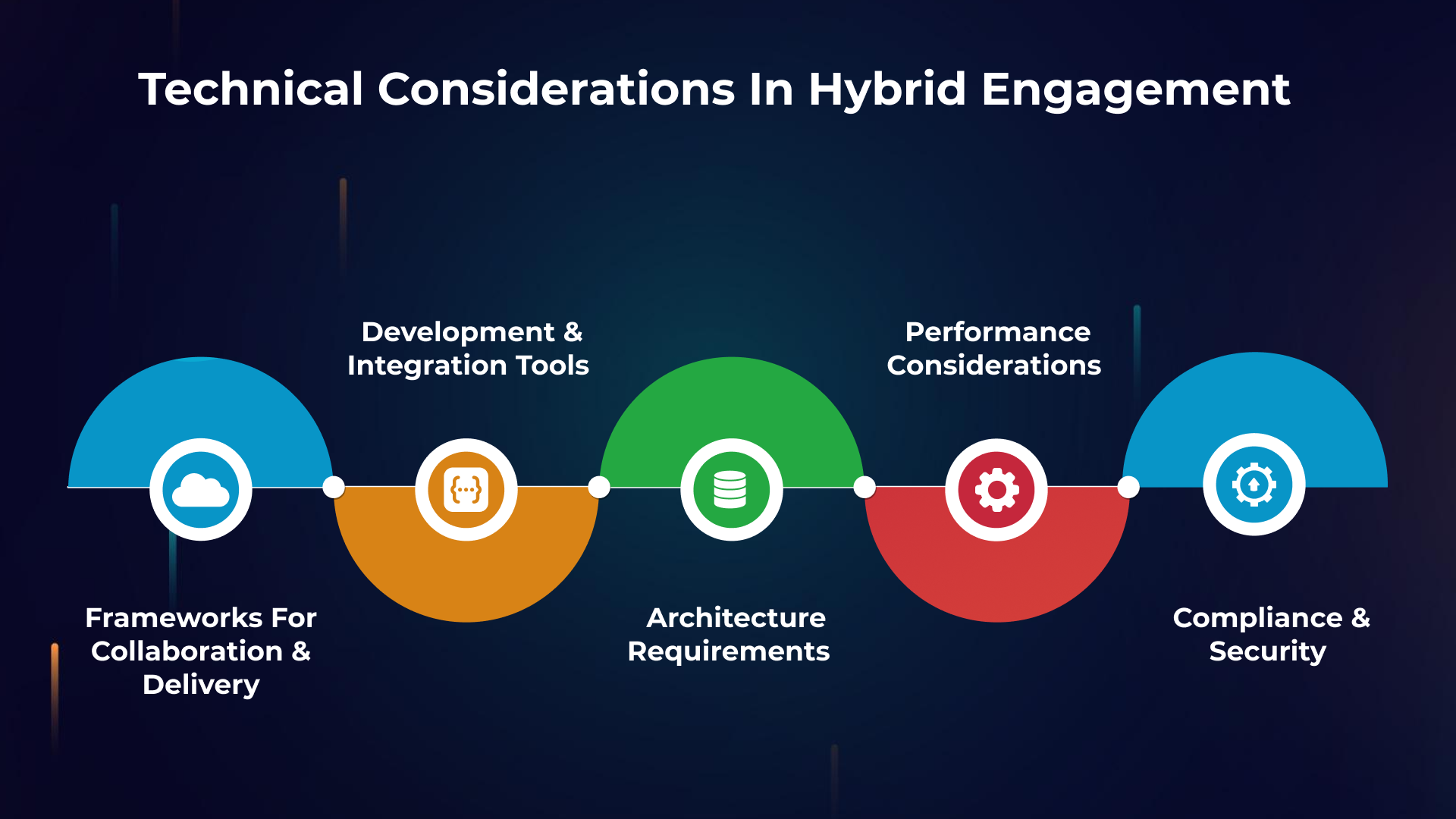
Technical Considerations in Hybrid Engagement
Technology architecture and delivery frameworks are the factors that decide if a hybrid model will be a powerful source for growth or an operational inefficiency.
1. Frameworks for Collaboration and Delivery
Hybrid agile delivery ensures teams maintain regular sprint cycles, uniform backlog management, and coordinated release governance.
Onshore leadership is responsible for defining the roadmap, prioritizing the sprint, and validating the release. Offshore teams are mainly engaged in development and testing, which are done on a large scale.
2. Development and Integration Tools
Technology platforms serve as the control layer for cross-border execution. To enable efficient global team collaboration, a standard toolchain is necessary. Planning tools such as Jira, version control with GitHub or GitLab, CI/CD pipelines with Jenkins or Azure DevOps, and real-time communication via Slack or Microsoft Teams enable consistent, seamless coordination across distributed teams.
The key to successfully distributed DevOps is a robust, locally operated DevOps pipeline. An offshore developer should be able to carry out the same operations of development, testing, deployment, and monitoring in the environment as an onshore architect, without the need for any delays or manual handoffs.
3. Architecture Requirements
Legacy systems reduce the effectiveness of hybrid delivery because tightly coupled components and fragile dependencies limit flexibility and scalability.
To operate a hybrid-first environment, it is necessary to have modern, modular architecture with the following basic principles:
- A microservices-based, architecturally designed system to allow independent ownership of services
- API-first integration for maintaining a flawless connection with distributed systems
- Containerization through Docker and Kubernetes to be able to share the same environmental standard across different regions
4. Performance Considerations
In hybrid configurations, performance engineering often becomes a centralized offshore skill. These are continuous processes: automated scalability testing, cloud optimization, load testing, and system monitoring.
Platforms for unified observability make sure that application health is visible everywhere. This structure reduces performance risks in high-traffic production environments and enables proactive optimization rather than reactive firefighting.
5. Compliance & Security
The primary hurdle to trust in secure offshore development is security. Businesses need to incorporate security into both operational and architectural layers. This covers safe CI/CD pipelines, data encryption, multi-factor authentication, vulnerability scanning, and zero-trust access models.
Offshore compliance requirements such as ISO 27001, SOC 2, HIPAA, PCI-DSS, and GDPR should be incorporated into the contract and continuously audited.
Governance & Management Layer
Hybrid delivery can go beyond governance levels to serve as an integrated control framework rather than a reporting function. Efficient governance merges engineering execution, program management, business leadership, and compliance supervision into one operational structure.
Key governance components include:
- SLAs drive Performance Metrics.
- Risk Escalation Frameworks are established across regions.
- Integrated Quality Assurance.
- Security checkpoints are established between areas.
- Financial Transparency and Commercial Alignment across the World.
Best Practices for a Successful Hybrid Model
- Establish governance before scaling teams.
- Create the system architecture so that each module has its own owner.
- Standardize delivery processes globally.
- Automate security across the lifecycle.
- Consider the offshore teams as the partners in innovation.
- Use data-driven performance management.
Conclusion
The hybrid engagement model has become a foundational enterprise delivery strategy rather than a transitional outsourcing approach. When engineered correctly, the hybrid software development model delivers cost efficiency, global scalability, regulatory confidence, and sustained innovation velocity.
Hybrid engagement is not a compromise between offshore and onshore teams. It is a strategic operating model that unifies global talent into a single performance-driven delivery engine.
For organizations looking to implement or strengthen their hybrid strategy, Telliant helps enterprises adopt secure, scalable, and governance-led delivery across offshore and onshore teams.