

- Who We Are
- Who We Help

FinTech
Healthcare
-
- What We Do
Microsoft Azure Solutions
Maintenance
Strategy
Project Rescue
MVP Development
Project Types
-
- How We Work
- Resources
- Careers
You could be forgiven for not being familiar with the term “age-tech,” but there is no denying that it is a rapidly-developing segment of the tech economy. Investors, developers, corporations, startups, and venture capital firms are seeking to make their mark on this corner of the market, and age-tech solutions are beginning to pop up in portfolios all over the world.
What is Age-Tech?
“Age-tech” refers to the fast-growing suite of technology solutions aimed at meeting the needs of the world’s aging population. Tech is no longer a “young person’s game” — especially since the 54+ population contributes about $45 trillion to the world’s economy. By 2050, one in six people will be over the age of 65.
Age-tech solutions run the gambit from health and wellness apps to end-of-life planning assistance, to housing and employment solutions, to caregiving, to social apps. Age-tech is primarily intended to help people live longer, fuller, healthier lives, and to empower people to have more control over their lives as they age.
Key Segments of Age-Tech
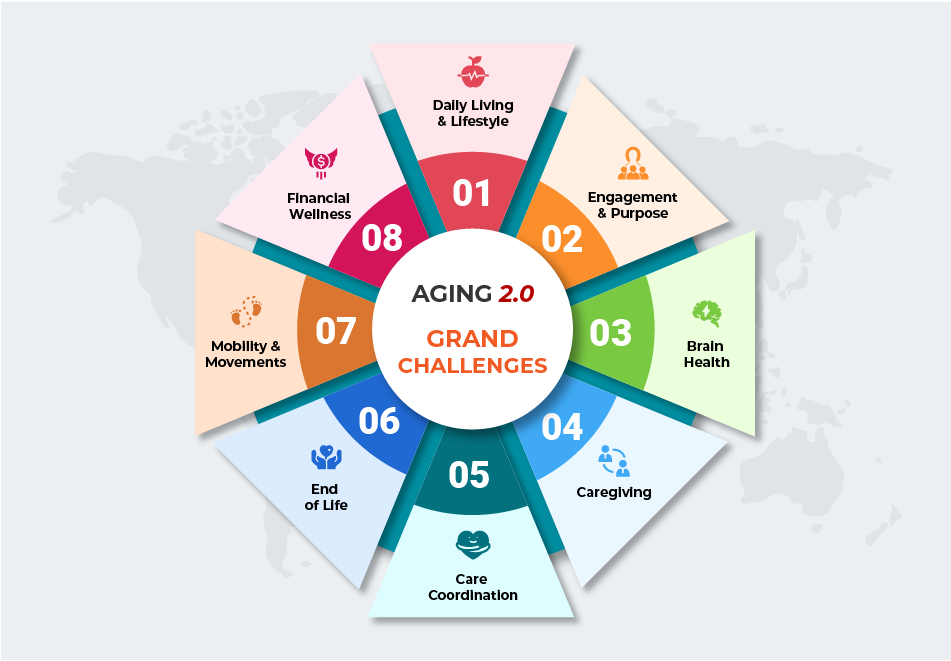
Age-tech solutions exist across many economic sectors, but there are a few key segments in which age-tech is particularly useful.
- Finance
- Health
- Cognitive Health
- Social & Connectivity Needs
- Mobility & Transportation
- Activities of Daily Living
Health and wellness is the largest age-tech sector, with about 23% of age-tech startups existing in this category. Operations (daily living) and caregiving are the next largest sectors, with about 15% and 12% of age-tech startups emerging in these categories, respectively.
Major Players in the Age-Tech Space
The majority of age-tech companies exist in the US and United Kingdom. Age-tech is primarily a startup market at this time, meaning that new companies are emerging to provide solutions, rather than existing tech giants dominating the space.
Some of the top players in the age-tech space today include Honor, a company that achieved unicorn status in 2014 and is the largest player in the $500 billion home care market; The Helper Bees which provides assisted living solutions for seniors; and GetSetUp, a digital community for seniors to learn, share, and socialize.
What is “Aging in Place”?
Aging in place refers to the desire of older people to remain in their homes and communities to lead lives that they choose to live, rather than being forced to live in assisted living facilities. Aging in place is a major objective of the age-tech sphere, and most age-tech solutions are geared toward helping older people achieve this goal.
Super Apps are still a relatively new concept and term for most people in the United States, although they are beginning to change the way the world does business. To consider whether you might incorporate a Super App strategy as part of your mobile strategy, you might look at what super apps are and consider how they are used today.
What is a Super App?
A Super App is a software application, typically provided on a mobile device, that provides users with an extended set of features addressing multiple use cases. For example, a super app might handle your wallet electronically, manage payments, help you order grocery deliveries, book ride shares, stream media content, purchase event tickets, and more.

Super apps are increasing in popularity as teens and twenty-somethings, who were raised with smartphones, demand all-in-one powerful mobile solutions.
Why should I care about Super Apps?
Super apps are beginning to replace multiple separate apps we are already using. For users, this may mean getting comfortable with new digital ecosystems to gain easier access to efficient, one-stop solutions that make their lives better. Super Apps can better fit into the lives of users, simplifying their world.
For developers, Super Apps present opportunities to target a broader range of customers, add additional income streams, differentiate their businesses and create stickier products.
Key Use Cases
In their current iteration, Super Apps are used primarily for e-wallets, e-payments between friends and family, food delivery, ride-hailing, and other forms of e-commerce. Eventually, though, it’s forecasted that Super Apps will expand into almost every area of our lives.
E-wallets – A Major Type of Super App
E-wallets have been the initial “killer app” combining a set of services and activities found in physical wallets that people intuitively understand make sense to be offered together. Almost all Super Apps today provide e-commerce solutions (e.g. handling payments and managing money) as an integral part of their solution.

One of the leading super apps currently on the market worldwide is ZaloPay, a Vietnamese e-wallet that enables users to make electronic bill payments (e.g. electricity, water, internet, TV), handle money transfers (via QR codes) and make cash withdrawals and deposits with the user’s bank.
WeChat – A Case Study
No discussion of Super Apps would be complete without mentioning WeChat. At first glance, WeChat appears to be similar to WhatsApp – a social networking and messaging app that allows users to share messages, and make voice and video calls.
But for the majority of people in China, WeChat is much more than a social media app. While it is China’s biggest social media network, it also allows users to call a cab, book train & flight tickets, shop online, purchase movie tickets, book a hotel, pay bills, and much more.
The app is embedded in many of its users’ lives. Indeed, some users report opening WeChat in the morning and not closing it again until the end of the day. In 2018, WeChat had over 1 billion users and has grown since.
Super App Strategies
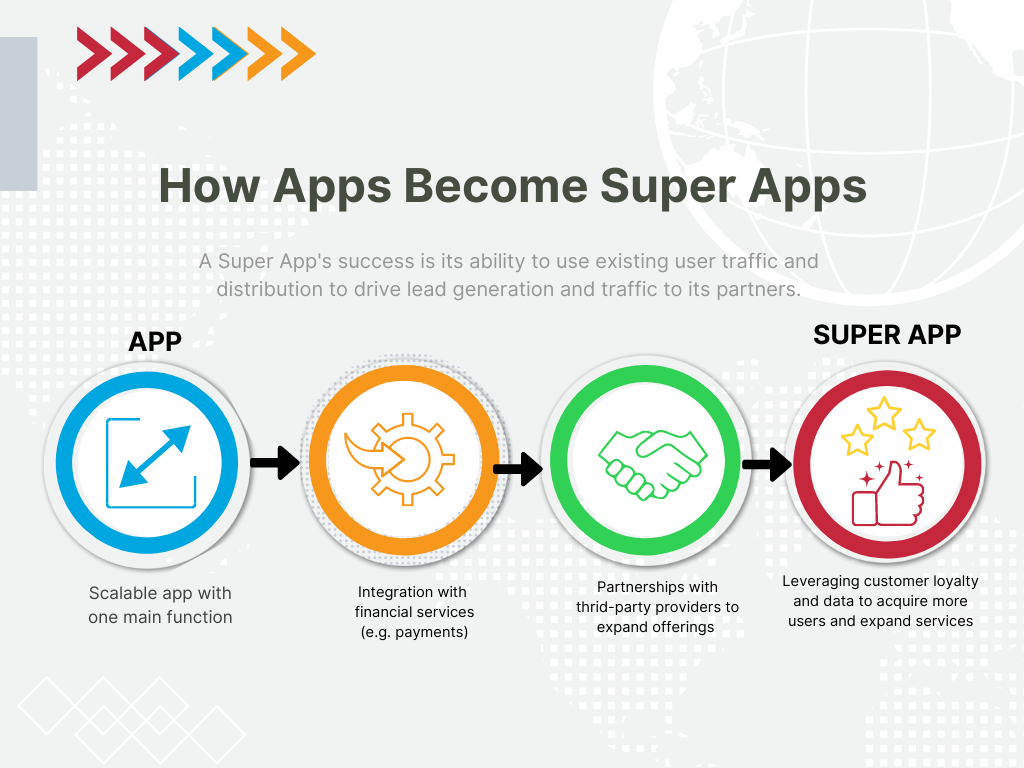
So what’s the strategy behind a successful Super App? I believe there are three key factors to building a strong app to differentiate your offering. Addressing all three will provide a much better chance of generating dramatic growth for your business.
Strong Core Features
A Super App must have a strong core use case that addresses a specific problem for its users, regardless of how many features it has. WeChat, at its core, is a social media app whose other features are powerful and necessary as well.
Solid Payment System
Super Apps today are typically built around a robust payment platform to handle e-commerce transactions. This capability provides many apps the ability to offer additional financial features such as checkout and e-payment solutions, an e-wallet, bill payment options, and a smooth interface for users to manage their finances.
Third-Party Apps
Most Super Apps do not typically build all their own features and solutions themselves. Rather they form partnerships with other companies while integrating their third-party solutions. WeChat, for example, integrates many “mini programs” from other companies, including JD.com, Walmart, Rothy, and King Power into their solution.
Whether your software product may be a core module or an additive feature, it may make sense to build your product into a Super App.
Every successful product development project starts with a plan. Without one, you’re reducing the odds that your new product will deliver on your vision and its potential. This post will share a few ideas on how important a product roadmap can be to the success of your product development process and will suggest some tools to help you build your roadmap. More importantly, a good product roadmap is an essential management tool to translating your product strategy into an actionable set of projects to deliver on your product vision over time.
A product roadmap helps you visualise the product(s) you want to create, understand how you’re going to create them and plan how to track success of the project(s) to build them. A roadmap is an agile tool that provides a bird’s-eye-view of core product features, objectives, and priorities at each phase of development.
This helps ensure that you and your stakeholders are on the same page, that each member of the product development team understands the bigger picture and their roles on the team, and that everyone can track the team’s progress throughout the project(s).
Some product managers downplay the importance of a product roadmap because it may be considered “old” or “rigid.” But that’s not necessarily true. An agile product roadmap is flexible as it borrows conceptually from the concept of agile product development. It is a living document updated regularly to keep current with customer needs, emerging trends, competitive pressures, technological advances, changing strategic priorities of the business and changes in your team’s design and development velocity.
What Happens if You Don’t Create a Product Roadmap?
Without a well-defined product roadmap, you may very well experience:
- An inability to track and measure progress effectively.
- A delayed or stalled project from unnecessary delays in product development.
- Little-to-no accountability from team members if there are no clearly defined tasks.
- Timeline and cost overruns.
- C-level execs who are disappointed when the product misdelivers on feature/ functionality.
- Dissatisfied clients.
Worse of all, lacking a roadmap can lead to abandoned projects.
However, if you want to launch a product that delivers on the company’s vision, capitalizes on the business opportunity thereby driving new revenue and comes in on time and on budget, you will want to create and use a product roadmap as a key management tool in your product development process.
Reasons Why a Product Roadmap Is Important to Product Development
Everyone associated with the team benefits from product road-mapping including management stakeholders, product owner, project manager, architects, designers, business analysts, developers, QA engineers and especially end-users. And if you use an outside, third-party development partner to help build your product, a good product roadmap will help clearly communicate your product objectives and goals to ensure everyone is on the same page. Other reasons why a product roadmap is warranted?
Establishes Organizational Leadership and Maintain Discipline
A well-defined roadmap helps project managers delegate tasks and clarify responsibilities for each member of the team. This maintains discipline and organizational leadership as everyone understands their role at each phase of the project, and provides a timeline to help make team members accountable to each other and the roadmap itself. Timelines help the team track progress at each stage and sprint helping ensure the ultimate delivery date is met.
Keeps Stakeholders Current
A good product roadmap provides a visualization of the individual projects on the roadmap and their status. It is much easier to keep the CEO, CTO, product owners and others in the loop with a well defined roadmap.
Helps Developers Focus on Priorities
Roadmapping helps developers and other team members better understand the overall product giving them a clear visualization of critical priorities at each phase. This helps them focus on important tasks making quick and autonomous decisions, while managing scope creep more effectively. Developers aren’t waiting for confirmation as they understand what to do at each stage of the project.
Good Tools for Product Roadmapping
Product managers can leverage several free and paid tools to create their own roadmaps. Many of these tools have templates you can download and edit to include your preferences to avoid starting from scratch. Take a look at these tools….
Conclusion
A product roadmap is a key management tool to help product owners and managers translate their product strategy into individual projects that deliver on the company’s long-term business objectives. It is important to remember that a product roadmap should be flexible and that each product feature or idea does not have to be built now.
Typically, on this site we write about topics related to technology, product development and business & strategy. Today I would like to take a slight detour to share a little about our interest in one industry we spend a lot of time in, digital health, and our interest in supporting our local technology community.
Georgia is home to a very robust digital health community with over 250 core digital health companies and approximately another 225 organizations which support the core companies. Since Telliant is very active in healthcare and digital health, we are a big believer in supporting this community locally in Georgia. For example, Telliant is a member of the Technology Association of Georgia (TAG), the largest statewide technology association in the U.S. with 30,000 members across all industries, and has several executives serving on society boards. For example, our CEO Seth Narayanan is on the board of the Digital Health Society and I am the chair of that society. In addition, one of our senior account executives, Bill Brady, is on the board of the Supply Chain Management Society. We support TAG and several of its societies with speakers, sponsorships and volunteering to support its mission and activities.
One of the ways we have supported TAG and the general healthcare community is by playing a major role in helping TAG’s Digital Health Society to conceptualize, design, build and launch the TAG Digital Health Ecosystem platform & database. Launched on March 30th this year, this platform has profiles on more than 475 companies and organizations in the digital health and healthcare community in Georgia, articles and stats on the ecosystem and a calendar of events hosted by all digital health organizations in the state, including TAG Digital Health.
The Georgia Digital Health Ecosystem is available free to everyone without having to be a TAG member. Check it out here and see if your company has a preliminary profile already listed. If so, you are welcome to adopt your profile (after proving you work for the company) and add information to it. If not, and your company is registered in the state of Georgia and has operations in the state, you can create a new profile and add it to the database.
Telliant built the site and will maintain it for TAG Digital Health as the society continues to add companies, articles, industry data and events info going forward. We have provided this platform free to TAG, the Digital Health Society and the technology community in Georgia as a give-back to the community which has been so supportive of us.
As TAG Digital Health Chair, and as a proud Telliant associate, I would like to invite digital health companies in the state of Georgia to add their company profile to the database or edit their profile if already listed. You can add or edit your profile at https://digitalhealthecosystem.tagonline.org/, clicking on “Company” in the Nav bar and selecting the appropriate option.
Attitudes toward product and project management are shifting. These days, a traditional project management-based approach for product development is often eschewed in favor of a more flexible product management approach. Companies are choosing to embrace the often messy, and certainly more difficult to implement, “product mindset.”
What is a product mindset and why is it important? How can you leverage it to drive results for your business and deliver more value to your customers?
What is a Product Mindset?
A product mindset emphasizes the importance of a long-term approach to product development and product management, rather than a temporary, milestone-based approach. The product mindset is rooted in the tenets of a growth mindset where “failing fast”, “excelling at change,” and “continuous evolution” are embraced. One key pillar of the product mindset is fostering a consultant-client relationship with customers as opposed to a vendor-customer relationship. Customer needs are continually observed and a continuous-release cycle is adopted whereby customer feedback is considered and adopted in many cases in coming releases. This allows a company to “launch and move” (on to the next phase) while providing opportunities for testing and retrospectives.
How is a Product Mindset Different from Project Mindset?
The project mindset works under the assumption that work will be predictable enough to break down into known constraints like budget, scope and a timeline. It relies on milestones that can be readily measured and repeated. It works really well in fields like construction, where one project is very much like another. For example, there may be slight differences in how one data center is built vs another, but these differences are unlikely to be large enough to warrant an overhaul of the entire construction process. Generally, project managers can rely on known milestones to track progress and understand the value delivered to the end client. In software development, this sort of mindset leads to immediate problems. The needs of end-users are constantly shifting, so utilizing a time-tested, repeatable development pattern typically isn’t a realistic approach. Rather, companies must adopt a more agile approach; continuously gathering data from users and business owners and using that data to inform each step of the design and build process.
How Can Your Team Implement a Product Mindset?
Here are three things to keep in mind when considering moving your company to a product mindset.
Focus on the User, Not the Technology
Project mindset-based approaches often focus on what’s possible given current technology, rather than what users want and need. Design and build with the end customer’s needs in mind from the very beginning. This means utilizing techniques such as RUM (Real User Monitoring), A/B testing, canary releases and user interviews to gather actionable data from users. Then use that information to inform your product development.
Fail Fast, Fail Often
Successful companies are not afraid to fail. Rather than spending months building and optimizing the “perfect” solution, the product mindset would have you release an imperfect product – the best product for today – and begin gathering end user data immediately and incorporating learnings into your sprint plan. If that product fails, figure out why, address the failure point(s) and move on.
Plan for the Long-Term
Rather than creating and approving a budget and a team for each new project, consider building a team and a budget for ongoing investment into the product. Instead of asking “how long until this is done?” consider asking “how long until our customers receive value from this?” Instead of asking “how much will it cost to build this feature?” ask “how much will it cost to deliver value to our customers with this feature?”
The shift from “done” to “validated” is not an easy one. It requires businesses to become comfortable with the idea that a product might never fully be “done.” It requires an organization to invest in teams long-term, to empower them to iterate quickly, test, fail and repeat.
Adopting a product mindset requires companies to move beyond measuring core metrics and fully embrace the complexity and fluidity of a changing market. It’s not an easy transition to make. But in today’s software product development landscape, it will be a major difference maker for the companies that do it.
The Lean Startup, written in 2011 by Eric Ries, changed the process of product development by introducing several new concepts. Chief among them was the idea of starting with a minimum viable product, or MVP, to build, test and validate the core features of a new product before developing the final product.Collecting end-user feedback early in the process and iterating with quick improvements helps get to a more productive product earlier in the process and avoid failure. In today’s software development world, developing an MVP is common practice.
An MVP should include features that address the end-user’s major pain points, while limiting the number of features included to those considered core to the product. Additional features can be added in subsequent updates to build a more complete product. An MVP allows the development team to prioritize core functionality and features in order to provide maximum value to the end-user while collecting feedback for quick updates.
Developing an MVP allows the product owner to minimize upfront costs while focusing on the most important user priorities initially. Let’s discuss a few of the most important factors when developing an MVP.
Conduct Market Research
42% of startups fail because there is no market need. MVP development follows a three-step process to ensure a new product meets a market need: Learn – Build – Measure. The first step in building a successful MVP is understanding who the application is being built for. Who is the target end-user? What are his/her major pain points?
Data-driven market research can help identify user demographics, pain points and needs, backgrounds, position in the ecosystem, device preferences, level of experience with technology and other factors.
Hiring a professional market research agency to help with this is great if available. However, that isn’t always necessary. If companies know their markets and end-users well and can be open and objective, they can conduct their own research through surveys, interviews, online research and competitive research. Spending time understanding end-user desires, pain points and current solutions will help identify the most important features to build into the application. Analyzing competitors objectively is also important to understanding which features to include in order to create points of differentiation.
Identify Key Objectives
It is important to establish a primary objective when building an MVP. Whether building an application for user research, market validation, investment or selling purposes, having a primary objective will help provide focus and clarity of decision making as the team works through the project. The product owner will want to establish the primary objective and ensure the entire team understands the objective. This will help resolve many issues before arising and will help settle disputes when they do arise.
Choose Core Features
A good MVP development plan includes creating user personas for key target users and applying learnings from the market research to establish the product’s Unique Value Proposition (UVP). The UVP, or unique selling proposition (USP), is a concise, straight-to-the-point statement about the benefits the product offers customers. It’s an explanation of what makes the product different.
When you understand the end-user, his/her goals and your vision for the product, you will be able to identify the primary features to incorporate into the product. Selecting features that address end-user needs and opportunities while differentiating the product competitively will form the basis of a unique and valuable product.
Think through the User’s Journey
Once key features are identified, it is important to think through the mind of the end-user(s) and understand how they will interact with the product. Creating a workflow diagram for end-user(s) will cause the product owner to consider all key user interactions in the user’s journey, identify potential pitfalls and avoid unnecessary features and missteps. This will help avoid rework during the development phase.
Build the MVP
It’s important to consider the technology stack, team members required for the development phase and development methodology when planning the building phase. When selecting a set of technologies for your MVP, it helps to think about the following:
- The product’s functionality: The MVP’s functionality and features will determine the choice of technology. Is the application going to be a web, mobile and/or enterprise app? Will it be on-premise or in the cloud? Does it need to connect to other applications to share or consume data? Does it need to store and quickly access data?
- Scalability: Although the MVP isn’t the final product and will likely have limited reach in the beginning, planning the architecture to be scalable for later growth will save later rework.
- Ease of Changes: It will be important to have the flexibility to make quick changes to the MVP post-launch with the customer feedback that will be collected.
- Development Methodology: Another major consideration is the software development methodology. Though many companies still employ a traditional waterfall process, more organizations today than not utilize one of several versions of an agile development process. This is too detailed of a discussion for this post, but more can be found on wikipedia on the subject. Be sure to scroll down to the section “Agile Software Development Methods” to see a list and descriptions of the 15+ agile methodologies. Choosing agile over the traditional waterfall is recommended here due to cost-effectiveness, seamless collaboration, ease of change, scalability, and faster software delivery.
Collect Feedback & Measure Results
Upon launching the MVP, it will be important to track the performance of the app(lication) and collect user feedback. This will help determine if the business’ and end-users’ needs have been met and what updates or tweaks will be needed in the next product update. In addition to customer feedback, identifying key business indicators in advance and creating a tracking and feedback process will ensure key learnings are captured. These learnings should be fed back to the product owner and design & development team to help determine improvements to make during the next sprints.
Conclusion
Building an MVP allows the testing of the viability of the product idea in the market and provides a feedback loop to continue working on the product in subsequent phases. It is also a cost-effective alternative and can provide some immediate income in some cases. Lastly, employing these ideas can help develop an MVP that better meets user’s needs, delivers on the product’s vision and business goals and gets the business into the market with a new product more quickly.